






Let's discuss the DMX512 system, along with the HG-803SA controller and the HG-XAP01 signal amplifier.
If you are working in the lighting sector, the DMX512 protocol is virtually unavoidable, from small stage lighting applications to large-scale architectural-type lighting applications. This brings me to what I wanted to talk about with you guys today. I am currently using this combination of equipment, specifically the HG-803SA, which is an 8-port controller, along with the HG-XAP01 signal amplifier unit.
Let's first define what each of the two device types is used for. Basically, one acts as the brain and the other functions as the legs of the device.
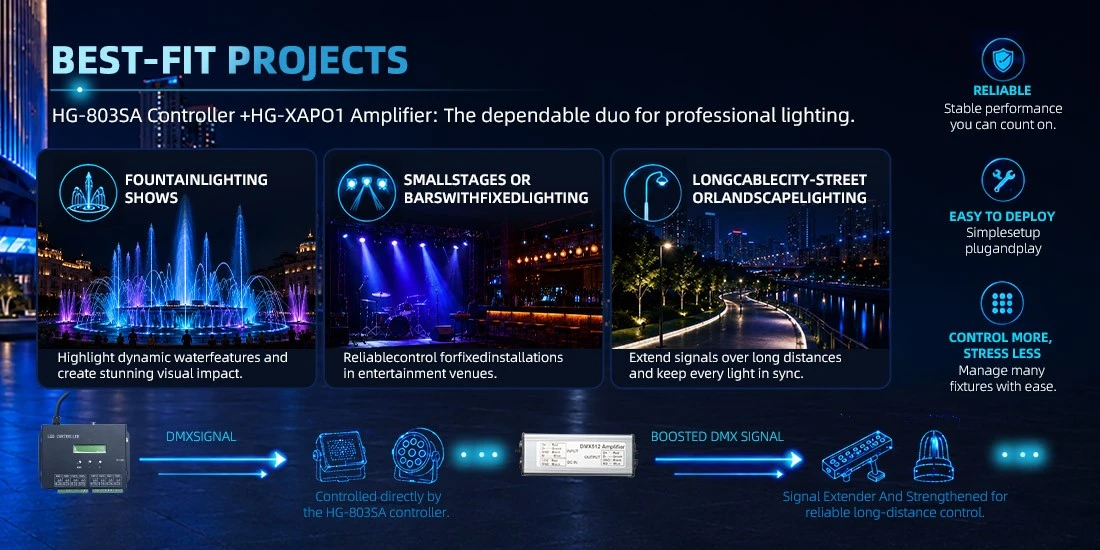
The HG-803SA Controller acts as the master unit for this particular device type. All of your desired lighting effects, such as chasing lights, smooth gradients, or abrupt color changes, will be based on the commands provided by the HG-803SA to operate your light.
The HGXAP01 amplifier is basically like a repeater, which increases the signal strength after its decline & provides clear, transmittable signals & accurate signals for a distance of several hundred meters and many more.
What makes this controller so cool?
My favorite thing about it is that you can use it without needing to have it hooked up to a computer. All you have to do is save your lighting effect(s) that you have programmed already to an SD card (There is a free 1GB SD card in the unit, and it comes preloaded with 30 default effects that are ready to be used as soon as the unit is turned on), put the SD card into the unit, and turn on the power, and the unit will start running. For the installations that are permanently installed, such as lighting for an architectural facade, or lighting for a commercial building exterior, you will not only be able to save the cost of buying a new dedicated computer, but you will also have the peace of mind knowing that you do not have to worry about your system going down (either by crashing, or an infection with a virus).
There are eight output ports available at the back of the unit. Every port can be attached to a daisy chain comprising about 170 lights. That suggests all eight ports can combine to control around 1360 lights. What does this mean in practice? You could light up the entire outer portion of an office building or light up pavement lights at ground level throughout a medium-sized public square, all under the control of a single control console, without having to buy extra sub-controllers.
In addition, you have access to flexible connectivity. The device is compatible with both XLR-3 type connections (commonly used in audio) and RJ-45 type connections (commonly found in Ethernet connector styles). This product can be incorporated into an entire Lighting Console System, or it can operate on its own to produce previously programmed lighting effects.
Can we truly benefit from using a little amplifier (HG-XAP01) here? Yes, it's great when doing a large outdoor project.
Remember that while a DMX512 signal is supposed to go 100m, you normally will start to lose signal at 50m to 60m due to various frequencies producing interference and cable quality issues when working outdoors. The lights will begin to flash irregularly, causing a lot of problems.
This device fits perfectly for such an application, as it can be inserted or connected between your signal path and will "boost" it back up to its full strength once again. In terms of output, the waveform is exactly identical to what you originally input, except now the waveform is significantly stronger. Because it weighs only 100g, it can be kept in a waterproof case and mounted on a utility pole or light stand.
Its Power Supply is also highly Flexible, as it accepts either a 12V or 24V DC Power Source or 110/220V AC Power. So, basically, as long as you have a Given Power Source Available to you, you can operate this Device with it.
What should I consider during installation?
The Polish installation process is very simple and easy to do; however, there are some very common mistakes made during installations that should be avoided:
Controller Wiring - Always make sure to shut off all electrical power before connecting any of the controller's wires! The operational voltage for this controller ranges from 110 Volts AC to 220 Volts AC; therefore, it will plug directly into any standard electrical outlet. The controller has eight (8) ports located on the rear side of the device. Therefore, you just need to connect those cables through which you want to control the lights of your home. Two brackets are provided on the rear side of the controller for mounting purposes, i.e., to fix the controller on the wall or an equipment rack with screws. Do not hang this controller in the air!
Placement of Amplifier
The following particular order of signal flow can be used to place the amplifier correctly: Output of Console > Input of Amplifier > Output of Amplifier (which goes on to the next set of lights or another amplifier). Do not mix up any of the connections, since each port is labeled with the word IN or OUT
SD Card – Be careful with the orientation of the card while you're inserting it. The side of the card where the brand name and model number are printed will be facing up (along with an arrow indicating the correct orientation of the card) - insert the card until you hear a distinct click, which means that you have correctly installed it. The system will read SD cards that are formatted with the FAT32 or FAT16 file system and have a maximum capacity of 64GB. Avoid buying SD cards that are formatted in the exFAT file system because the system will not be able to recognize those cards.
How do I change the controls while it operates?
The unit has a small monitor and several keys located on the front. It is, therefore, a simple machine to operate.
There is a button called MODE. The MODE button will scroll through all of the available setting displays and each of its individual settings, which include: selecting a particular "File Number", "Speed" settings, "Brightness", or "Loop Mode".
Selecting a File will go like this: you are going to play the third sequence of the lighting effect, then you will select the file you want to play, say File03; to select it, you will use"+" and "–" to select your file. Adjusting Speed and Brightness will go as follows: the "Speed" or "Bright" button can be pressed, then you use the plus key (increase) and the minus key (decrease) to adjust.
Loop Modes include "ALL" (which will play all files in order) and "Single" (which will repeat the file that has already been selected).
Parameters such as "DMX Address" and "Channel Count" (the default of 3 channels representing RGB fixtures) are generally okay to be set at their default values, unless you will be synchronizing multiple control consoles together or using a specific type of LED chip.
Projects This System Works Well With:
The system performs well in the following settings:
Bridge and architecture lighting - Simultaneously controls hundreds or even thousands of individual lights via pre-programmed light pattern shows stored on an SD card without needing any personnel on-site.
Small stages or bars (fixed lighting) - such places where you want to avoid having to run a computer or lighting console to every event or show; just have your desired effect saved beforehand, and your show will start with a simple flick of the switch.
Long cable projects - such as a city street which has hundreds of meters of LED strip- placing an HG-XAP01 amplifier every few meters apart will keep the first fixture in sync with the last!
A final honest review
This isn't the coolest hardware combo, but it's one that you can count on to work every time you need it to be dependable. You might compare the HG-803SA to a diligent foreman, while the HG-XAP01 acts as the messenger sent out by the foreman. After you have created your effect files- and that's a very simple thing to do with the included software- you power up the system, select your mode of operation, and just let it do the job for you. This option is an optimal solution for individuals who are looking to have full control of a significant number of light fixtures without dealing with a lot of additional stress.